Showing posts with label Techno Stuff. Show all posts

Wearable Technology: Data Storage


I recall to have write something related with wearable technology somewhere in my blog and it turns out the world has gone better than that simple shirt. VTT, a business technology group has now designed several wearable technology in the form of ring, functional fingernail and wristbands.


Through a product they called "inTouch", it allows you to store data temporarily for it to be transferred from source device to a destination device. According to VTT, this technology could also be used in healthcare (well...) and in the future, may serve as an extra layer of security where passwords are stored only in this device and is used for online accounts or even unlocking doors.


See video below:


Source: Here and here

Thought Control Quadrotor

Since the discovery of brainwave by Hans Berger, neurologist from Germany, more advance applications are made to utilize the brain function, which includes using brain to give instructions to physical object. The video below shows several experiments done by researchers at Zhejiang University, China regarding thought control. 


If the explanation isn't clear, here's a sort of what the lady said in the beginning:

"Flying Buddy2 is developed to ease the life of a disable person. It consists of electroencephalography headset, AR Drone and a computer. The computer can receive the EEG signals via bluetooth and convert them to specific (unclear, morse?) to control AR drone through wifi computer program"

Well, that's what i heard. Nevertheless, the system is utilizing the brain wave with the main purpose being for the betterment of the disable. The possibility exists that the same system can be used by normal people and when the difference between men is narrowed down to only their thought pattern, one can assume that a training to enhance thought pattern to develop stronger brainwave signal is of importance. 

And since the human brain is not yet fully understood, imagine how thought pattern of a single person can affect the physical world. The Fringe series, has an episode regarding this. 


While it's interesting to see how neuroscience provides an insight to new technology, one can see the importance of putting a limit to the advancement of technology so that no unwanted catastrophe being cast upon mankind because of their 7 deadly sins. 

Harvesting energy from insects in quest to create tiny cyborg first responders

An insect fitted with piezoelectric generator to harness the energy from the insect's wing.
Insects have served as the inspiration for a number of Micro Air Vehicles (MAVs) that could be deployed to monitor hazardous situations without putting humans in harm's way. Now researchers at the University of Michigan College of Engineering are proposing using actual live insects enhanced with electronic sensors to achieve the same result. The insect cyborgs would use biological energy harvested from their body heat or movements to potentially power small sensors implanted on their bodies in order to gather vital information from hazardous environments.

To harvest energy from insects, the researchers have designed a spiral piezoelectric generator that converts the kinetic energy from the insect's wing movements into electricity. This power would be used to prolong the battery life of devices implanted on the insect, such as a small camera, a microphone or a gas sensor. The prototype piezoelectric generator was fabricated from bulk piezoelectric substrates and was designed to maximize the power output in a limited area.

"Through energy scavenging, we could potentially power cameras, microphones and other sensors and communications equipment that an insect could carry aboard a tiny backpack," said Professor Khalil Najafi, the chair of electrical and computer engineering at the U-M College of Engineering. "We could then send these 'bugged' bugs into dangerous or enclosed environments where we would not want humans to go."

The U-M team examined several techniques to scavenge energy from wing motion with their results were published in a paper titled "Energy scavenging from insect flight," which was recently published in the Journal of Micromechanics and Microengineering. The university is now pursuing a patent for the technology and is seeking commercialization partners to bring it to market.

Getting the insects to go where their handlers want them to is another part of the puzzle that needs to be solved before insect cyborgs can be deployed. But DARPA has been working on this, having put out a call some years back for research proposals for Hybrid-Insects-Micro-Electro-Mechanical System (HI-MEMS) interfaces to control the movement of living insects. Combining the two technologies could be just the thing to take insect cyborgs to the next level and see them used to monitor hazardous situations in the not to distant future.


sources : http://www.gizmag.com/insect-cyborgs/20596/


Janken with 100% Winning Rate Robot

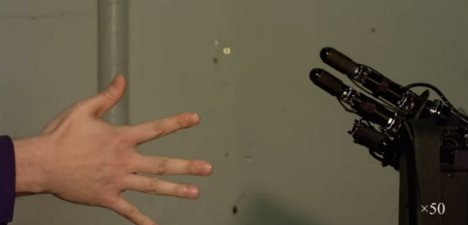
The game Janken or rock-paper-scissors is so famous that almost everyone know how to play it. In fact, recent news in the world of technology reveals the ability of a robot hand to play this game, and you'll never beat it.
The robot hand on the right is designed to have 100% winning rate
This robot was developed by Ishikawa Oku Laboratory (Japan, obviously) and with the super-duper high-speed sensor that'll read opponent's hand gesture, the robot will make a counter move that will beat the human's move.

Here's the video.
The purpose of this highly frustrating machine (cause you play the game and lose everytime) is to demonstrate its ability in real world situation where the robot must be able to react like human when necessary.

I hope the researchers can tweak the algorithms so that it can play rock-paper-scissors-lizard-spock just like in the series The Big Bang Theory.
Here's the graphical representation as to what Sheldon Cooper said in the video.

Certainly technology has advance quite fast and hopefully all of these achievements can give benefit to human in a peaceful way. 

50 Gigapixel Camera

A group of engineers from Duke University and University of Arizona recently have managed to build a camera with 5 times better than human vision of 20/20.

The camera was built by synchronizing 98 tiny cameras into one device and a computer processor will then compiles all the image captured by the cameras using a software developed by a team led by Michael Gehm.

The 50 Gigapixel Camera with 2 and half feet square and 20 inches deep

The typical consumer camera ranges from 8 to 40 megapixels only and by comparison, the image produced by this new camera will have 12++ more pixels than consumer camera. This undoubtedly will create an image with excruciating details.

Even with the 50 Gigapixel of resolution, the optic part of the camera only constitutes around 3% of the overall size of the camera and the rest is divided into processors and electronics used to assemble the information gathered by the optic.
Example of a picture taken by the high resolution camera
Currently, the highest amount of pixels in a picture is 272 Gigapixels, created by Alfred Zhao using 12000 images all taken in Shanghai, China. You can see the picture and the amount of details in this website. Engineers in this team claim that with smaller electronics and processors are being made, camera with this resolution may be able for general consumer and everyday photographers.

Source: Here.

Android Vs iOS

Sorry for the long hiatus. I bought Samsung Galaxy Tab 10.1 with 3G connection so that i can stay alert on news and stuff. One might ask as how the Android different from the iOS, so here's an easy infographic for those undecided as to which direction they should go. 

Android vs iOS Infographic

Source: Here

Terrafugia Transition: A Flying Car

The combination of air and land transport certainly would be the best for those who love to drive but hate the traffic. Well, Terrafugia, an American corporation has developed what would appear to be the first affordable flying car.


Equipped with foldable wing, Transition can moves 65 mph while on road and 115 mph while on air. Transition first successful take off was on 2009 with the supervision of FAA. Check this video out to see Transition's ability on both air and land.


Despite its ability as transportation vehicle, spectators expect that the cost for mass production of Transition will exceed the selling price, which is at 280 000 USD. I think most of the money is spent on extremely light and expensive carbon fiber. Since it falls under light-sport aircraft, you're gonna need to have a sport pilot license in order to fly.

All in all, this is a good way of showing that the world's technology is advancing. Personally, i like the hoverbike more. Read more about hoverbike news here.

Source: Here and here.

Gymbot - Cool Personal Fitness Trainer

First, some facts from WHO:

  • Worldwide obesity has more than doubled since 1980.
  • In 2008, 1.5 billion adults, 20 and older, were overweight. Of these over 200 million men and nearly 300 million women were obese.
  • 65% of the world's population live in countries where overweight and obesity kills more people than underweight.
  • Nearly 43 million children under the age of five were overweight in 2010.
  • Obesity is preventable
Overweight and obesity will be the world's no 1 problem if it is not treated and prevented. Due to this problem, Gymbot, a concept robot presented at the ICSR 2011 design award is used in order to help humans especially in obese people to have a healthy lifestyle. 


Max Battaglia, the designer of Gymbot, hope that this robot will coach the owner in term of exercise, eating habit and healthy lifestyle. It can use the sensor to analyze not only the owner's activity, but also his/her body composition so that it can give advice on how to get healthier. 


This concept robot is meant to motivate and encourage overweight people to live healthily and well, there's nothing scarier than a big, bulky scary humanoid telling you what to do or else he'll beat the crap out of you. According to the designer, this robot may exist in 2020 where there are great improvement in technology that make the robotics become more affordable. 


Hopefully with this robot around, problems associated with obese can be eliminated and people can spend more time on other problems.

Source: Here and here.

3D Printing: Human Organs and Chocolate

A long time ago i posted something about 3D Printer. But the world does not stop at just that. Now, with time, 3D printing is advancing towards medical and food industry. 

The success story of printing body parts:

Organovo, a company pioneering in bioprinting technology has successfully created the first commercial organ printer in the world. The printer, called NovoGen MMX Bioprinter, is now capable of producing arteries which is commonly used by surgeons to do bypass surgery. By using the patient's own cell, the threat of rejection by organ transplant is greatly reduced. The company hopes that the machine will be able to print more complex organ such as heart and liver in the next 10 years. With capabilities to save thousands of lives that need organ transplants, NovoGen can be considered as the latest breakthrough in the world of medicine. 
Roadmap to bioprinting
Watch the video of the printer. 


Chocolate Printing:

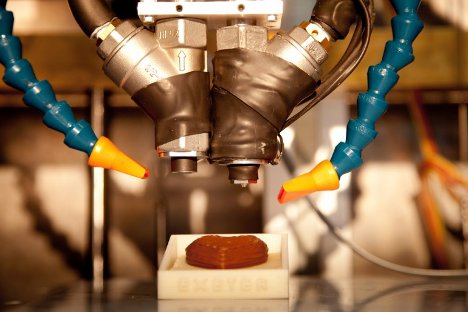
Engineering and Physical Science Research Council (EPSRC) is now researching the 3D printer so that it can print custom design chocolate. This printer will allow user to design his/her own chocolate and bring it to reality. The challenge in creating this printer is to melt and temper the chocolate at the right temperature but it is one challenge that can be overcome. With the 3D printing technology becoming more and more commercially available, this research can help in revolutionizing the business of manufacturing process worldwide. 


Source: Here and here.

Vending Machine for Cash

With the world of technology advancing everyday, we now can experience a whole new environment. But this advancement has its own cost, most obvious is the effect towards nature. But thanks to ecoATM, now we can recycle electronic products (cellphones and digital music players) in return for cash. 


What ecoATM developed was a kiosk or a vending machine that allows you to sort of trade in your phone for cash. In normal vending machine, you will put your money in return for goods but in this vending machine, you will need to put your unwanted cellphones in return for cash. 


With this machine in every mall in town, definitely unused electronic products can be managed in a more proper manner without damaging the mother nature. I think so far the machine only accept electronic items that can be used, which means broken or damaged product aren't acceptable. Nevertheless, it is without a doubt a wonderful tool for someone who hates his Iphone and wanted some cash to buy Blackberry. Watch the video below to see how the machine works. 


Source: Here and here

Visualizing the Petabyte

Computer technology is advancing more and more each day. We can have a 1GB storage media that is much cheaper now as compared to 10 years ago. We are reaching the petabyte age and below is a useful graphical information to understand the value of Petabyte.


Source: Here

Awesome Watches...Seriously


These are no ordinary wrist watches. These are watches that tech-savvy people should have on their wrists but only if they the cash in their pockets or banks cause these time-giving masterpieces are not for the unfortunate.

The Tread 1 is no ordinary watch . According to Devon, it is made by a patented system called Interwoven Time Belts but reinvented.This what gives the belt it's singularity. The belts are powered by compact microstep motors providing power and accuracy, which is the important to watches. Counting 86,400 seconds per day is a task that human bestowed upon watches, certainly not an easy task. The watch is powered by a lithium polymer battery and one charge will last you a couple of weeks.


The son of a famed French watchmaker Jorg Hysek, Jorg Hysek Jr, design the stylish and awesome if I do say so myself the HD3 Slyde which has an LED screen with a sapphire crystal cover that curves to conform to your wrist. With no physical buttons, the watch has just three battery indicator lights on the side and a light sensor to automatically adapt the brightness of the screen. Everything is controlled by taps or slides on the touchscreen. So high-tech indeed.


AES Encryption


Ok guys, its been awhile since I last posted anything here but to avoid any nagging from admin I decided to up the ante for my next post. Here for all who is interested about encryption and computer security, a brief explanation about one of the basic encryption algorithm that all of them whom call themselves |-|4xx0|2 (if you don't what is this go learn about 1337). AES is simple in terms of implementation but complex in terms of production. Both simplicity and complexity is one the requirements for the AES when it was first proposed. I have to warn you th at this kind of stuff is not for the weak hearted and mind (seriously). This is a very complex thing but I know some people would have no trouble understanding.

The Advanced Encryption Standard (AES) is an encryption algorithm for securing sensitive but unclassified material by U.S. Government agencies and, as a likely consequence, may eventually become the de facto encryption standard for commercial transactions in the private sector. (Encryption for the US military and other classified communications is handled by separate, secret algorithms.)
In January of 1997, a process was initiated by the National Institute of Standards and Technology (NIST), a unit of the U.S. Commerce Department, to find a more robust replacement for the Data Encryption Standard (DES) and to a lesser degree Triple DES. The specification called for a symmetric algorithm (same key for encryption and decryption) using block encryption (see block cipher) of 128 bits in size, supporting key sizes of 128, 192 and 256 bits, as a minimum. The algorithm was required to be royalty-free for use worldwide and offer security of a sufficient level to protect data for the next 20 to 30 years. It was to be easy to implement in hardware and software, as well as in restricted environments (for example, in a smart card) and offer good defenses against various attack techniques.
The entire selection process was fully open to public scrutiny and comment, it being decided that full visibility would ensure the best possible analysis of the designs. In 1998, the NIST selected 15 candidates for the AES, which were then subject to preliminary analysis by the world cryptographic community, including the National Security Agency. On the basis of this, in August 1999, NIST selected five algorithms for more extensive analysis. These were:
  • MARS, submitted by a large team from IBM Research
  • RC6, submitted by RSA Security
  • Rijndael, submitted by two Belgian cryptographers, Joan Daemen and Vincent Rijmen
  • Serpent, submitted by Ross Andersen, Eli Biham and Lars Knudsen
  • Twofish, submitted by a large team of researchers including Counterpane's respected cryptographer, Bruce Schneier
Implementations of all of the above were tested extensively in ANSI C and Javalanguages for speed and reliability in such measures as encryption and decryption speeds, key and algorithm set-up time and resistance to various attacks, both in hardware- and software-centric systems. Once again, detailed analysis was provided by the global cryptographic community (including some teams trying to break their own submissions). The end result was that on October 2, 2000, NIST announced thatRijndael had been selected as the proposed standard. On December 6, 2001, the Secretary of Commerce officially approved Federal Information Processing Standard (FIPS) 197, which specifies that all sensitive, unclassified documents will use Rijndael as the Advanced Encryption Standard.
The Advanced Encryption Standard (Rijndael)
The block cipher Rijndael is designed to use only simple whole-byte operations. Also, it provides extra flexibility over that required of an AES candidate, in that both the key size and the block size may be chosen to be any of 128, 192, or 256 bits. (During an early stage of the AES process, a draft version of the requirements would have required each algorithm to have three versions, with both the key and block sizes equal to each of 128, 192, and 256 bits. This was later changed to make the three required versions have those three key sizes, but only a block size of 128 bits, which is more easily accomodated by many types of block cipher design.)
The original description of Rijndael is available at: http://www.esat.kuleuven.ac.be/~rijmen/rijndael/.

However, the variations of Rijndael which act on larger block sizes apparently will not be included in the actual standard, on the basis that the cryptanalytic study of Rijndael during the standards process primarily focused on the version with the 128-bit block size.
Rijndael is a relatively simple cipher in many respects.
Rijndael has a variable number of rounds. Not counting an extra round performed at the end of encipherment with one step omitted, the number of rounds in Rijndael is:
  • 9 if both the block and the key are 128 bits long.
  • 11 if either the block or the key is 192 bits long, and neither of them is longer than that.
  • 13 if either the block or the key is 256 bits long.
To encipher a block of data in Rijndael, you first perform an Add Round Key step (XORing a subkey with the block) by itself, the regular rounds noted above, and as already noted, the final round with the Mix Column step, as described below, omitted.

Now that you know a bit about this type of encryption, here is an example of what the encryption looks like kinda. You can download a pdf from:

Ryno Electric Unicycle

This unicycle, designed by Chris Hoffmann is definitely a must have gadget for students to maneuver around campus. Designed to help people like security guard patrolling a large area, this unicycle can reach up to 25 mph and can move up to 30 miles journey. 


Hoffmann has already received pre-order which will be around $25 000 but the designer expects the market price would be around $3 500. See the video and judge it yourself.


Pretty neat, huh?

Source: Here

Physical Storage VS Digital Storage

I would like to say thanks to all people involve in making our life easier.


Source: Here

Electronic Contact Lens


University of Washington

Back in 2009, a contact lens in the works that displayed visual feedback right before your eyes, just like the 'Terminator Style' is being researched. Well, two years and a few months later, Professor Babak Parviz has a working model. He has given the new lens to rabbits, and reports complete success.
The device's display has only one pixel, but serves as a working proof-of-concept for developing more complex information lenses. A useful device would need hundreds of pixels at least, to display a short email or text message.
The lens harvests energy from an external source using an antenna and has an integrated circuit to store the harvested power and transfer it to a transparent sapphire chip with a single blue LED. Unfortunately, while the range of the display was about one meter in free space, that range was reduced to about two centimeters when it was placed on the eye.
Another of the challenges facing the creation of a Terminator-style eye display is that the minimum focal distance of a human eye is only a few centimeters. This means that information displayed on a contact lens would appear blurry. To address this, the researchers used thin Fresnel lenses to magnify the display.

Engineering Galaxy

Before anything, you should make sure your download speed is high. And watch the video. 


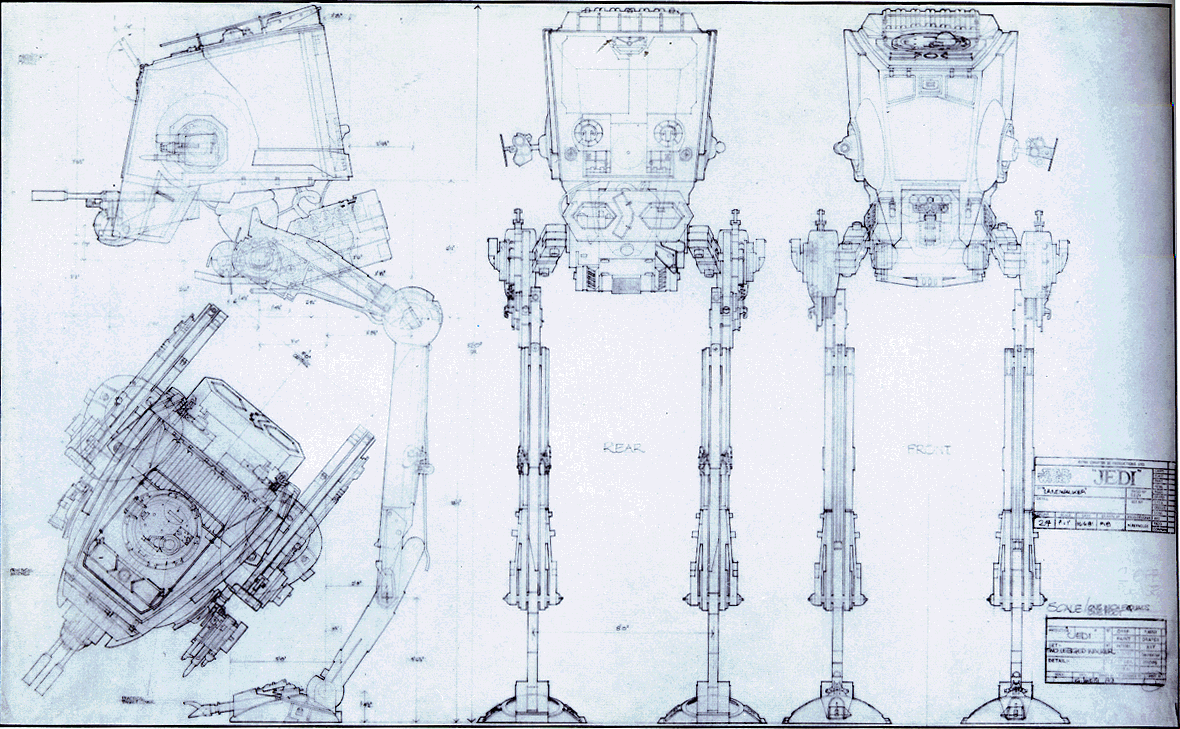
The entire star wars galaxy was actually built from scratch and for the first time ever, the blueprints of all the magnificent environment behind this fictional movie is released to public. 

More than 200 drawings, 500 photographs of all the blueprints in Star Wars are in this book. Believe it or not, this maybe the only book that tells you how galaxy is engineered.


These pictures are just part of the book. The book, was released on fall 2011 and only 5000 English language copies were printed. With the price of $500, this book may be the only way to save mankind if 2012 doomsday really comes!

Source: Here and here.

Iris: A True Tablet PC for Anyone

Well, the world is certainly growing faster int terms of technology. Even as we speak, companies are developing their products in order to dominate the techno world.

The most famous tablet PC in the world, IPad.
Few years back, the late Steve Jobs introduced Ipad to the whole world which renders almost all companies to try inventing a tablet PC. And among the new inventions and design, a new tablet PC designed by four designers, Liu-Wei, Yao Kai-Chi, Hong Ruei-Hong & Cheng Ya-Fang, will definitely have chance in dominating the tablet PC market.

What they've designed is a transparent tablet PC, in which they called Iris. This tablet PC is using OLED screen and a transparent body, allowing the user to see through the tablet like seeing through a transparent glass. This is how Iris looks like:


Like other tablet PC, this tablet is equipped with speaker, camera and also tiny scanner. By activating the camera, according to gajitz, "this tablet can make a variety of augmented reality applications possible." Well, let's just see what this tiny thing can do that makes IPad sucks.


Well, if you want to have a mobile map that will show you where to go, definitely Iris is better. You can view the real life street with direction of where you're going. This helps especially if you're a tourist or new to some place that you've never been before.

Iris helps you in organizing your place. You can rearrange anything in Iris until you satisfied before you start arranging stuff only to find out that you don't like the arrangement.

With the help of scanner, Iris can translate whatever you're reading into your desired language. You just need to put Iris on a book, the scanner will process the words and boom, the translated text appears!

Also equipped with a sliding bar, Iris can separate the screen to allow you to do multiple works at the same time. Or if you want to share your screen with someone, just put the sliding bar in the middle and you can open different applications at the same time.

Imagine how many useful applications can be associated with Iris for example, VeinViewer. Or maybe at last, we'll have X-Ray scan just by using Iris. Well, I sincerely hope that they've already working on it because I'm gonna need one.

Smart Shirt to Make Hospital Less Scary

Being in a hospital definitely means there's something wrong with you. Especially after seeing all those big, scary machines with wires all over them. But now, thanks to a team at the Universidad Carlos III de Madrid in Spain, hospital is less scary and people are no longer attached to big wiry thingy and sit on their bed all the time.

Smart Shirt

What this team invented was something called "Smart shirt". This shirt can help doctors in monitoring patient's heart rate, blood pressure and temperature. On top of that, using wireless connection, they can perform echocardiogram (EKG) remotely, eliminating the need for staff to present during the test.


This smart shirt isequipped with GPS, well the actual reason is from it being stolen, but it is also used to track patients because they can wander around easily with this shirt. And if the patient wearing this cloth suffers from heart attack, fall, or any medical problems that require immediate attention, hospital staff can find him/her quickly using GPS. Also equipped with accelerometer, nurses or doctors can monitor if this patient is standing up, sitting, or lying down.


For every medical check up in a hospital, you'll get a free treatment for stress and a pleasing view.

Hopefully this shirt can help to make hospital less scary and more people will want to go to hospital for regular check up. But i definitely want this to be my own personal property!

Source: Here

New Way Of Creating Metamaterial

Well, if you have never encounter what the f*** is metamaterial, then click here. 

Uli Wiesner from Wesner Lab, has shown how to create metamaterial by using chemistry. The process involves in using what is called block copolymers to assemble 3-D structure in nanoscale features. 

Example of gyroid.


As you all know, polymer is substance that is made up by binding to molecules together to form a new material with new properties. A block copolymers on the other hand is the combination of two or more polymers. Now the two solid polymers will form geometric shapes with interconnected pattern that can be called as gyroid. More complex pattern or shapes can be achieved by using three polymers instead of just two. 

After this process, one of the polymers will be melted or dissolved, creating a hollow area which can be used to mold metal in nanoscale features, usually gold or silver. Now the gyroid consists of polymer and metal. The polymer is then burned, leaving the porous metal structure alone. Through all these process, Wiesner and his team researchers suggest that they can make the metal gyroid so that it can allow light to pass through. 


Maybe next time, the invisibility cloak is invisible through naked eyes, not some cameras or computers.

Using this process, the team said it is possible to create a materials with negative refractive index which is essentially metamaterial. The team now is conducting computer simulations to create the correct pattern for metal gyroid to be able to pass the light and have a negative refractive index in visible and near-infrared range. With this achievement, the world may be able to see cloaking device as has been seen in Star Trek or Harry Potter.