As world energy demand increases, there are talks about alternative energy being not enough to support the depleting fossil fuel. However, new discovery (well, relatively new) has been made and with the subject of nuclear fusion/fission to generate energy, Thorium, is said to hold the key.
Below is a good infographic about Thorium and its properties that enable it to become the future in providing the world's energy need.
Since the discovery of brainwave by Hans Berger, neurologist from Germany, more advance applications are made to utilize the brain function, which includes using brain to give instructions to physical object. The video below shows several experiments done by researchers at Zhejiang University, China regarding thought control.
If the explanation isn't clear, here's a sort of what the lady said in the beginning:
"Flying Buddy2 is developed to ease the life of a disable person. It consists of electroencephalography headset, AR Drone and a computer. The computer can receive the EEG signals via bluetooth and convert them to specific (unclear, morse?) to control AR drone through wifi computer program"
Well, that's what i heard. Nevertheless, the system is utilizing the brain wave with the main purpose being for the betterment of the disable. The possibility exists that the same system can be used by normal people and when the difference between men is narrowed down to only their thought pattern, one can assume that a training to enhance thought pattern to develop stronger brainwave signal is of importance.
And since the human brain is not yet fully understood, imagine how thought pattern of a single person can affect the physical world. The Fringe series, has an episode regarding this.
While it's interesting to see how neuroscience provides an insight to new technology, one can see the importance of putting a limit to the advancement of technology so that no unwanted catastrophe being cast upon mankind because of their 7 deadly sins.
Problems regarding weight has been well documented over the past decades or so. Diabetes, renal malfunction and high blood pressure which can lead to stroke are all associated with weight. Well, fear not, recent studies on John Hopkins University stated that there'll be an easy way to prevent and control this problem.
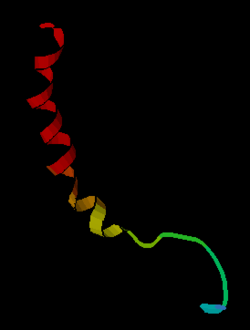
Neuropeptide Y - protein involves in regulating food intake and physical activity.
Researchers at the university found out that rat group injected with the virus ate less as compared to the control group. The virus is said to interrupt/attack/inhibit the process of Neuropeptide Y (NPY), an amino acid said to be responsible for energy regulation, learning and memory processing.
To make it even more surprising, the observation on the rat revealed that injected rat when given high calorie food, didn't convert them into white fat, but easy-to-burn brown fat instead. The virus is years from being able to be used on human though, but one can feel the ramification of this finding towards mankind.
p/s: i think the virus 'forced' the NPY to convert it to brown fat cause i don't think the virus is responsible for fat conversion. Well, it's just an opinion, i have no idea how it actually behaves though.
An insect fitted with piezoelectric generator to harness the energy from the insect's wing.
Insects have served as the inspiration for a number of Micro Air Vehicles (MAVs) that could be deployed to monitor hazardous situations without putting humans in harm's way. Now researchers at the University of Michigan College of Engineering are proposing using actual live insects enhanced with electronic sensors to achieve the same result. The insect cyborgs would use biological energy harvested from their body heat or movements to potentially power small sensors implanted on their bodies in order to gather vital information from hazardous environments.
To harvest energy from insects, the researchers have designed a spiral piezoelectric generator that converts the kinetic energy from the insect's wing movements into electricity. This power would be used to prolong the battery life of devices implanted on the insect, such as a small camera, a microphone or a gas sensor. The prototype piezoelectric generator was fabricated from bulk piezoelectric substrates and was designed to maximize the power output in a limited area.
"Through energy scavenging, we could potentially power cameras, microphones and other sensors and communications equipment that an insect could carry aboard a tiny backpack," said Professor Khalil Najafi, the chair of electrical and computer engineering at the U-M College of Engineering. "We could then send these 'bugged' bugs into dangerous or enclosed environments where we would not want humans to go."
The U-M team examined several techniques to scavenge energy from wing motion with their results were published in a paper titled "Energy scavenging from insect flight," which was recently published in the Journal of Micromechanics and Microengineering. The university is now pursuing a patent for the technology and is seeking commercialization partners to bring it to market.
Getting the insects to go where their handlers want them to is another part of the puzzle that needs to be solved before insect cyborgs can be deployed. But DARPA has been working on this, having put out a call some years back for research proposals for Hybrid-Insects-Micro-Electro-Mechanical System (HI-MEMS) interfaces to control the movement of living insects. Combining the two technologies could be just the thing to take insect cyborgs to the next level and see them used to monitor hazardous situations in the not to distant future.
There is a new clock that makes you wanna wake even if you don't want to cause you can't afford not to.
The Shredder Clock is just a concept, but it’s a pretty good idea, and a new spin on the notion that money is a great morning motivator. Other alarm clock inventions force you to feed them money before they’ll shut up, or automatically donate to charities that you hate until you get out of bed, but this one lets you see your money going to waste.
You could conceivably shred anything you find precious, from letters to pictures, not just money even summons if you want to risk going to jail.
This actually seems like a decent DIY project — it probably wouldn’t take much work to sync a paper shredder to your alarm clock although the outcome won't be as good as this.
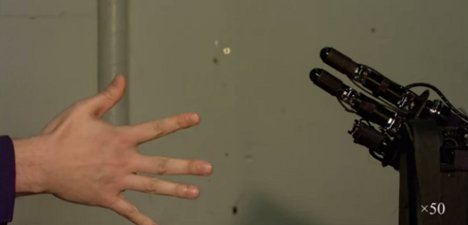
The game Janken or rock-paper-scissors is so famous that almost everyone know how to play it. In fact, recent news in the world of technology reveals the ability of a robot hand to play this game, and you'll never beat it.
The robot hand on the right is designed to have 100% winning rate
This robot was developed by Ishikawa Oku Laboratory (Japan, obviously) and with the super-duper high-speed sensor that'll read opponent's hand gesture, the robot will make a counter move that will beat the human's move.
Here's the video.
The purpose of this highly frustrating machine (cause you play the game and lose everytime) is to demonstrate its ability in real world situation where the robot must be able to react like human when necessary.
I hope the researchers can tweak the algorithms so that it can play rock-paper-scissors-lizard-spock just like in the series The Big Bang Theory.
Here's the graphical representation as to what Sheldon Cooper said in the video.
Certainly technology has advance quite fast and hopefully all of these achievements can give benefit to human in a peaceful way.
A group of engineers from Duke University and University of Arizona recently have managed to build a camera with 5 times better than human vision of 20/20.
The camera was built by synchronizing 98 tiny cameras into one device and a computer processor will then compiles all the image captured by the cameras using a software developed by a team led by Michael Gehm.
The 50 Gigapixel Camera with 2 and half feet square and 20 inches deep
The typical consumer camera ranges from 8 to 40 megapixels only and by comparison, the image produced by this new camera will have 12++ more pixels than consumer camera. This undoubtedly will create an image with excruciating details.
Even with the 50 Gigapixel of resolution, the optic part of the camera only constitutes around 3% of the overall size of the camera and the rest is divided into processors and electronics used to assemble the information gathered by the optic.
Example of a picture taken by the high resolution camera
Currently, the highest amount of pixels in a picture is 272 Gigapixels, created by Alfred Zhao using 12000 images all taken in Shanghai, China. You can see the picture and the amount of details in this website. Engineers in this team claim that with smaller electronics and processors are being made, camera with this resolution may be able for general consumer and everyday photographers.